
Interview: The Digger from Invader Comics
I talk to the creative team of writer T.S. Luther and artist Sam Gudilin

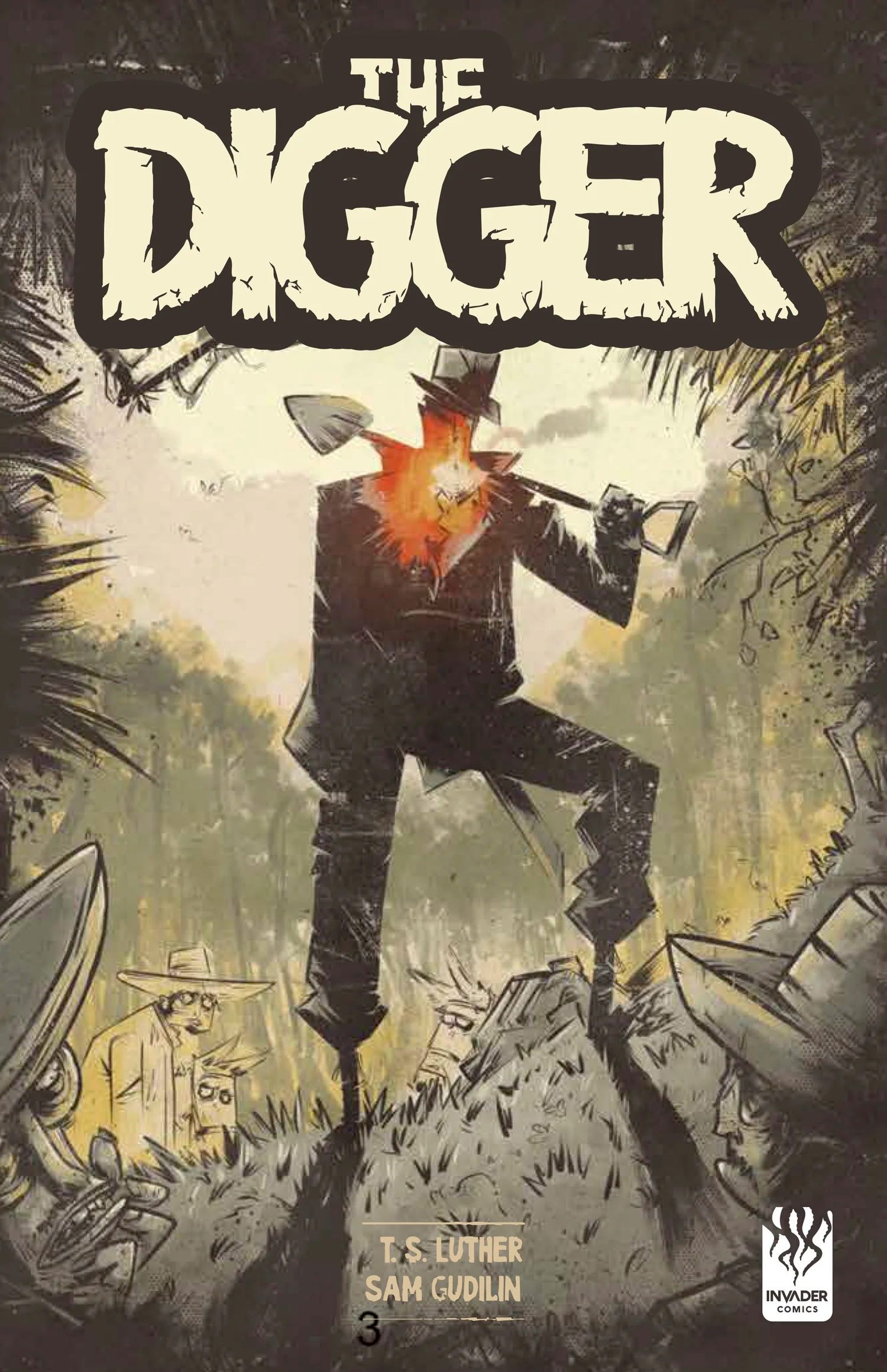
Back with another fantastic interview! Today I will be talking to T.S. Luther and Sam Gudilin about their series The Digger from Invader Comics. I was able to read the first issue before doing this interview and I really enjoyed it. It has very stylized visuals and panel work which match the story perfectly. Before reading I was already aware of who T.S. was because he is very savvy with his social media and is always popping up in my feed. I would learn we have a mutual friend (annoyance..just kidding Larry!).
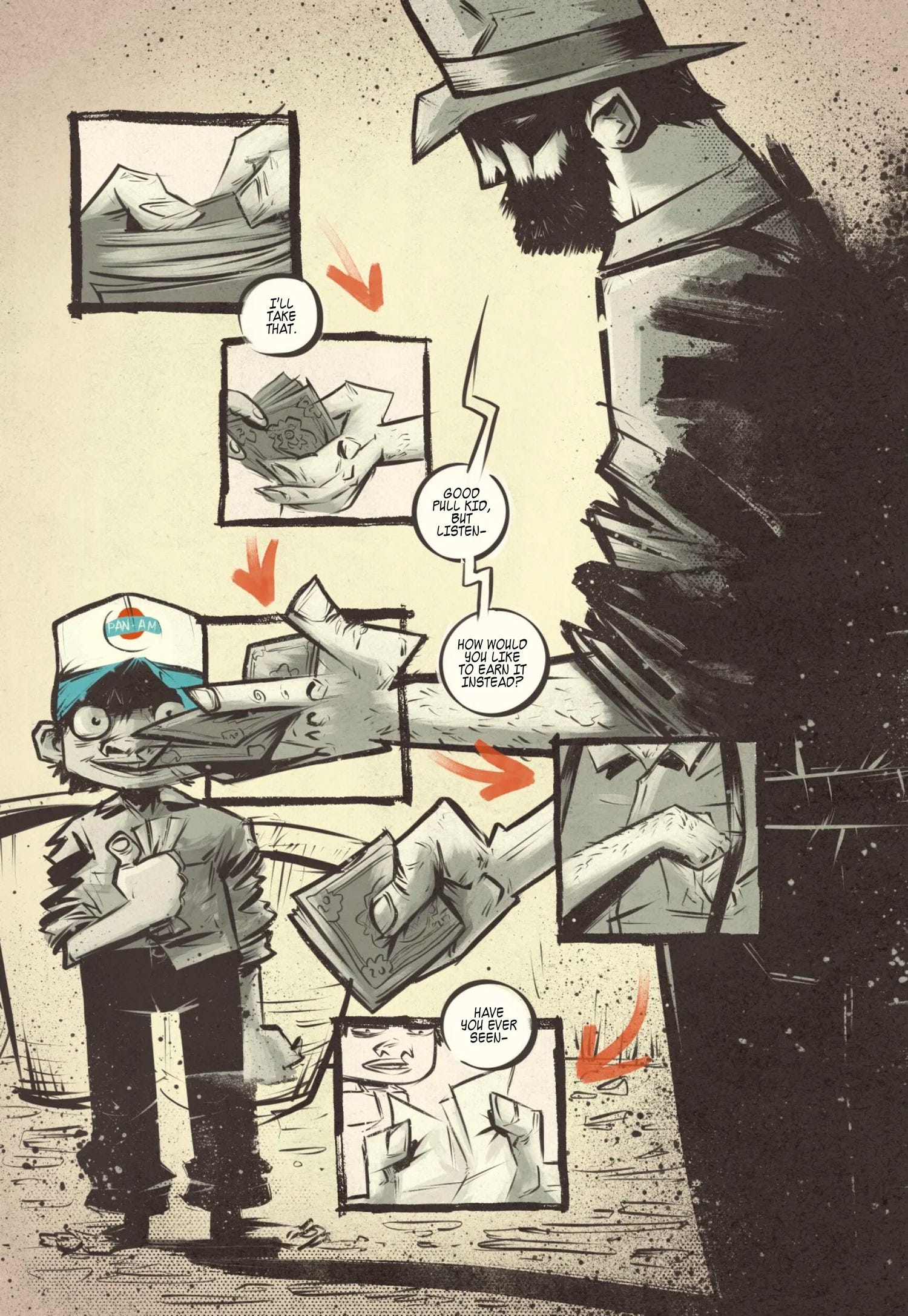
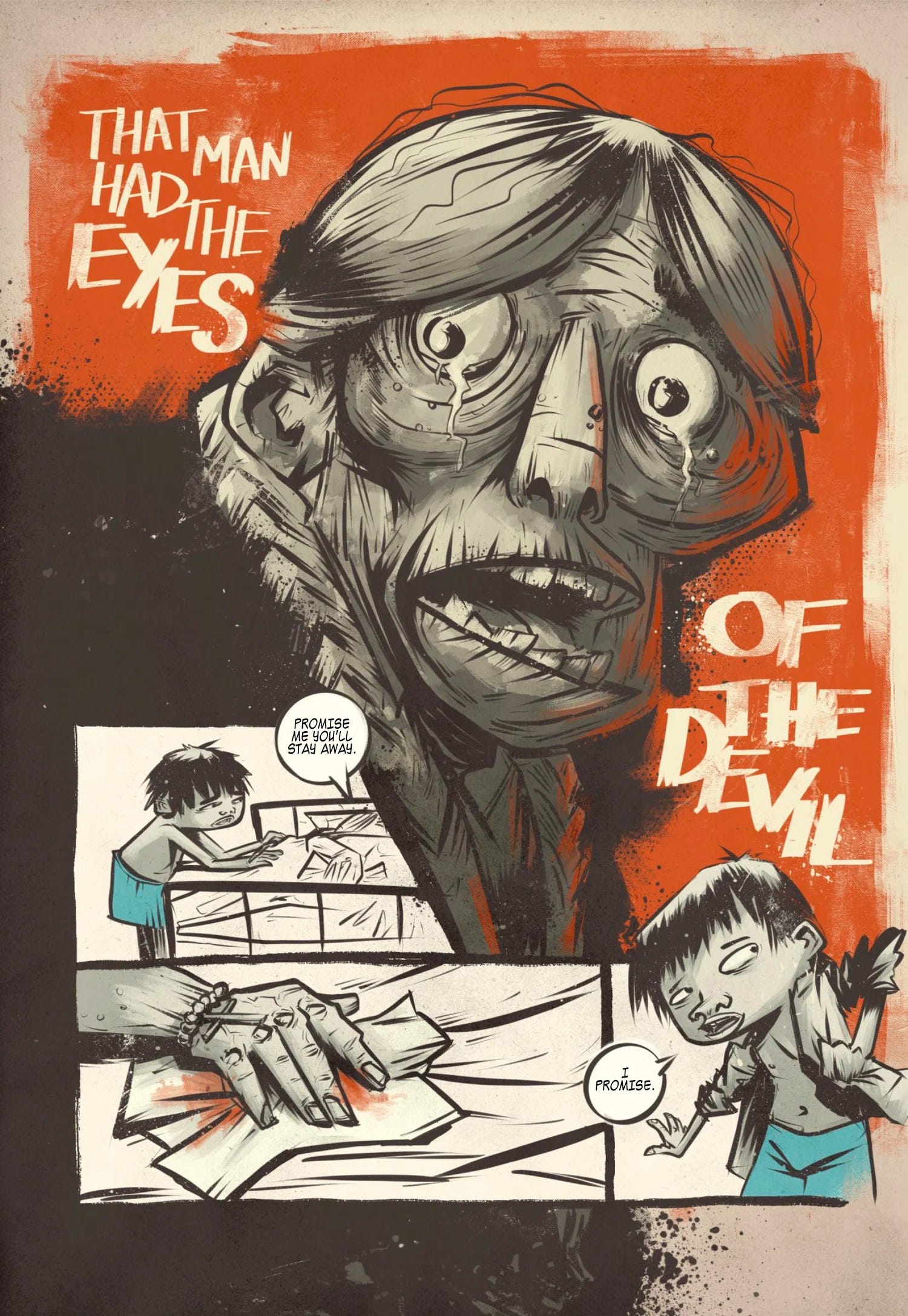
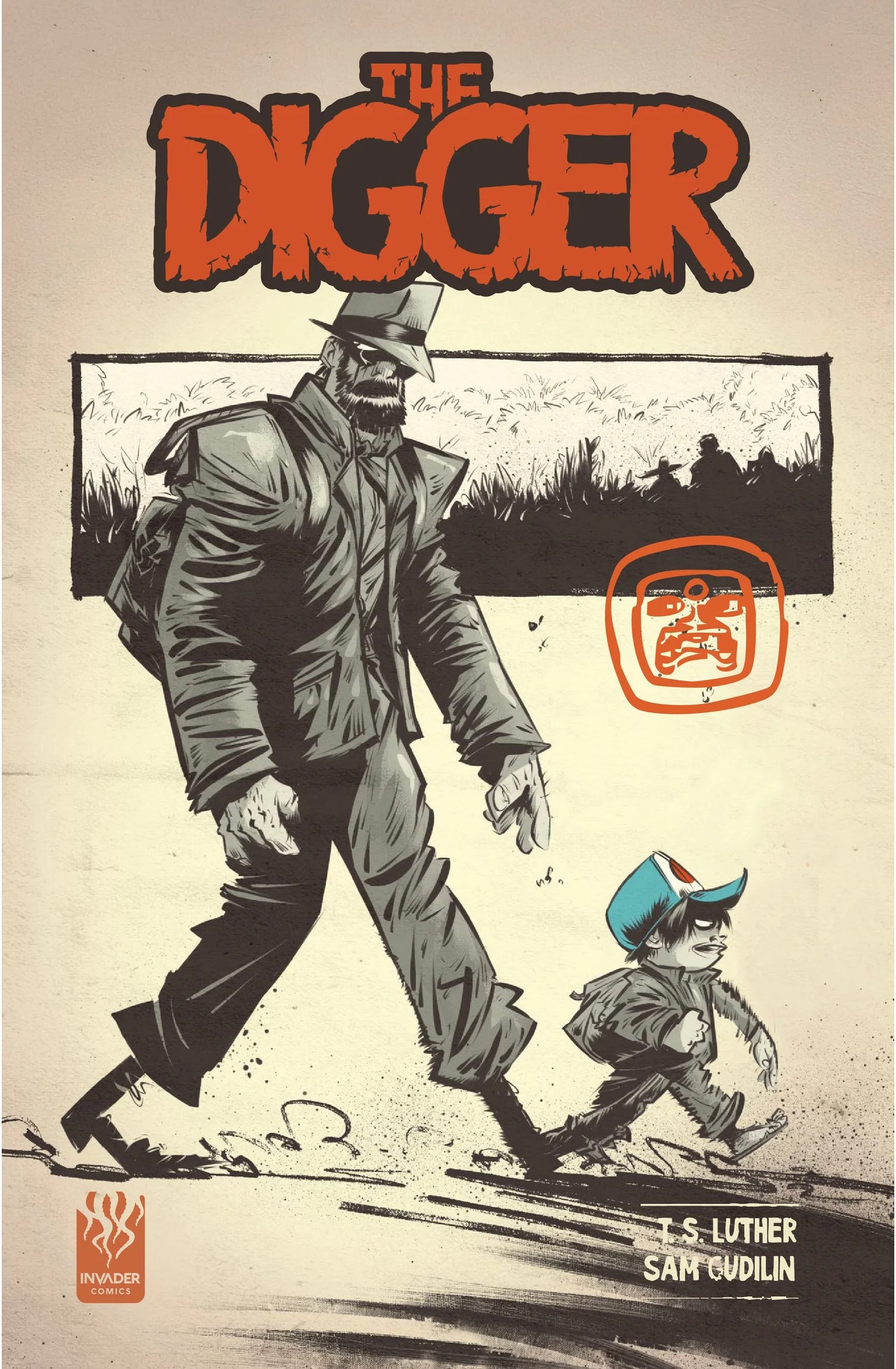
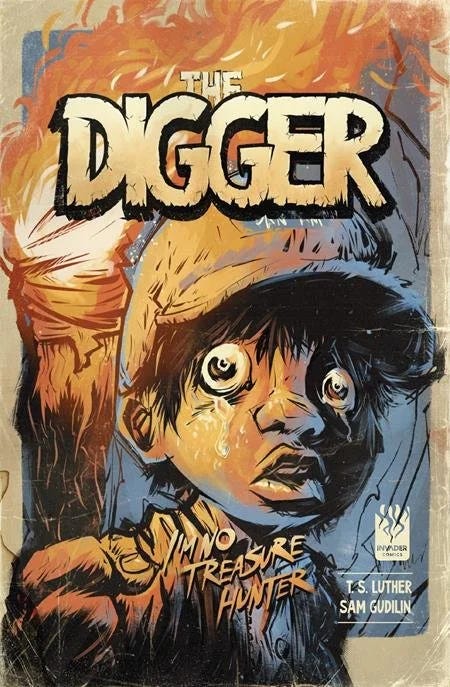
For those unfamiliar here is issue #1s official description: In 1930s Veracruz Mexico, along the Gulf Coast, lie Olmec ruins, all but hidden to anyone from the outside world. Locals make money guiding academics and scholars through the region. But there is one name that is spoken in hushed tones, one name guides stay away from, they call him “El Excavador”. But The Boy doesn’t listen to whispers, he hasn’t seen that no one returns from guiding The American in the hat. No, The Boy doesn’t know the man with the eyes of the devil. But, The Boy knows he needs money for his sick grandma, and The Boy knows The American has money, and The Boy KNOWS where the ruins are. What begins as guide and treasure hunter, turns into cat and mouse.
A second printing is on the way and you can find all of that info here:
https://www.invadercomics.com/
Austin Allen Hamblin: Before we get into your work I have a few questions I like to ask everyone. How did you come to comics as a reader?
T.S. Luther: My mom was a comics fan in the 60s (Dick Tracy, Spider-Man) so pretty early on she was handing me comics, trying to get me to read because novels weren’t my thing at the time. I remember reading Harry Potter when it first came to the states and it was just not my thing and so I thought I hated reading prose, turns out it was just Harry Potter that I didn’t like not reading in general lol.
I remember very early on, I had to have been 3 or 4, 97-98 somewhere around there I was just a little T.S. and for Easter my basket was filled with Superman comics. I hadn’t really seen much Superman stuff beyond the Donner movies here and there. So, this was my first real exposure to Big Blue Boy Scout. At this time the big event was the Death and Return of Superman. That’s what the toys were and the comics that were available in my backwoods area. So, I think the idea was some sort of Jesus metaphor to go along with Easter? Like Superman died and came back and so did Jesus…? I don’t know lol but in any case, this was my first brush with Superman and there he is on Easter morning dead and then resurrected looking wildly out of character, but I didn’t know that. So, for the longest time I had this weird ass view of Superman whenever other kids would bring him up. “Oh dude! Do you like Superman?”
“You mean the guy with a black suit, big ass mullet, and a giant laser gun? Hell yeah I like Superman!”
From there though, superhero comics were hard to come by basically living in the woods in the middle of nowhere Michigan. But you know what was available at the drugstore or the grocery store? Archie Double-Digest. So, that was my big into comics for YEARS, Superman looking like something out of Heavy Metal and Archie and the gang. That is, until Civil War happened and the book store in the next town started carrying more comics. That was legendary. I walked in and the sky opened up and the angels (who I assumed resurrected Superman as well lol) began to sing. I saw Spider-Man and Wolverine and The New Avengers there on a spinner rack for the first time. But they were different. Half their cover was just a solid color with the simple words “Civil War” printed on it. I KNEW this was a crossover event. I had heard tall tale of Onslaught fighting the whole Marvel Universe on the playground and from older brothers for years and this was that same thing…only this time I could be a part of it. I took every piece of change/lint from my pockets and called in every future birthday, Christmas gift, and ill-fated Easter basket from my mom and cleared out that spinner rack. I got every marvel title and even dove into DC with Teen Titans, Detective Comics, and Superman! (in the proper underoos this time) I’ve never left comics since. I haven’t always been able to clear out a spinner rack, but ever since that day comics has been a large portion of my story diet.
Sam Gudilin: I’ve been reading them since childhood, but I actually enjoy looking at them more than reading. Maybe it’s because there are very few comics where the visual storytelling and the story itself work well together — usually it’s either one or the other. But I’m always on the lookout for such stories. If the visuals are solid, it’s easier for me to enjoy the story.
One of the first comics I really liked was Bill Watterson’s Calvin and Hobbes. These little strips had a fun, slightly careless, and dynamic art style. As a kid, I also loved Indiana Jones from Dark Horse, with art by Dan Barry and inks by Karl Kesel. Then I came across Jamie Hewlett’s Tank Girl, which completely flipped my understanding of comics and everything I thought I knew about them.
AAH: What made you want to make them?
T.S.: I always wanted to be a storyteller. I just didn’t know what that really looked like. Growing up, no one around me ever had a job they liked let alone loved, and they definitely didn’t work in the arts. So, I didn’t really know it was an option. But I loved telling intricate stories with my action figures and what if scenarios on the playground. I annoyed the hell out of most people telling them my versions of what I thought should happen next in this game or that cartoon constantly. When I got to high school it really kicked into gear though. I started playing Dungeons and Dragons and all the adjacent TTRPGs and taking creative writing courses and for the first time, I wasn’t bugging people with my stories, people were ASKING for them. Teachers praising my writing (I never did well in school and didn’t go a lot, too much Marvel VS Capcom to play and too much Spider-Man to read), friends asking me to run a one-shot or help them with their character’s backstories. I finally found something I wanted to do.
It didn’t manifest into writing comics for another decade, but that’s where it started and the “why comics” for the chosen medium was just such an obvious fit, like when you find a puzzle piece that just HAS to be an edge piece. It couldn’t fit somewhere else. With comics you can tell any story you want. You’re not handcuffed by what can be done within the camera or specific CGI limitations, just what you can put down on a page and what an artist can draw. You really just need a few pencils. So, with near limitless potential and a love for the art, the medium, and the wide-arcing, shared universe, soap-operatic storytelling…it had to be comics.
SG: As a kid, whenever I saw something I liked, I just tried to copy it, but over time that evolved into something of my own. I wanted to tell stories about strange characters and add a bit of dark humor to them.
I love cinema, so I always tried to bring elements from films into my illustrations. Movies can convey emotion and tension so vividly — I’m always trying to figure out how to translate those things into comic panels. Not everything that works on screen translates directly into a drawn frame; you have to experiment, and sometimes something even more interesting comes out of it.
It worked both ways for me. When I was working at a company that made commercials, I brought comic book elements into the filming process.
The indie comics format lets you go wild with your creative vision, and that’s amazing. Every new story isn’t just another product off the assembly line — each time I try to do something different, go in a different direction. Sure, my overall style stays consistent, but I try to
reinvent certain things. That’s what draws me in.
AAH: Where did this story originally come from? I really get some manga vibes from it along with Western comics vibes.
T.S.: I was working on pitches that could be summed up a bit easier (I’ll get into why for Sam later lol), something that could be pitched at many levels, something I knew a publisher would want, but also something THEY could pitch if they wanted to license it or something. That’s where I landed on the sentence “What if Indiana Jones hunted Shortround?”
That’s basically all the pitch was, maybe a paragraph of explanation, and then me and Sam grew it together from there. Sam’s got such a knack for storytelling and what he wants out of a story and so we grew it together piece by piece from that logline. We wanted to tell this Indiana Jones like story, but with just a bit more honest lens. Sam and I are white dudes from opposite sides of the Earth and I was trying to find an “in” to this type of story that felt appropriate. Why should I be telling this story? I didn’t want it to be exploitation and if Indy were the “bad guy” that was something I’d feel comfortable with taking the helm on and it would fit a little closer to real world analogues. “It belongs in a museum!” is fun, but what if we lingered a bit on the questions like where did these artifacts come from? Who did you take them from? Why does it belong in YOUR museum? What did you DO to get it? That’s the eat your vegetables part of the story and we did a lot of research and had a lot of beta readers to make sure we did our due diligence on those things.
The other part of it was that fun “playing with Indiana Jones toys” of it all and showing a version of “How did Indy and Shortround meet?” that you get a brief piece of dialogue about in Temple of Doom. What if we blew up that off-screen story to be the whole thing and then once you put our unique lens on it, you get something truly awesome!
We both love old movies like Sorcerer and really wanted this to have that feel or to look like the old Pulp Adventure magazines and that’s where so much of the aesthetic comes from.
Plus, when you have someone like Sam, emailing you at 4 in the morning from the other side of the world saying things like “Hey…can you put a Jaguar in here somewhere? …I just really want to draw one.” It’s hard not to come up with something like The Digger.
AAH: The art gives off a lot of manga vibes. The panel work and layout on many pages is extremely unique, but isn’t confusing to follow in the slightest. What goes into your head when laying out a page?
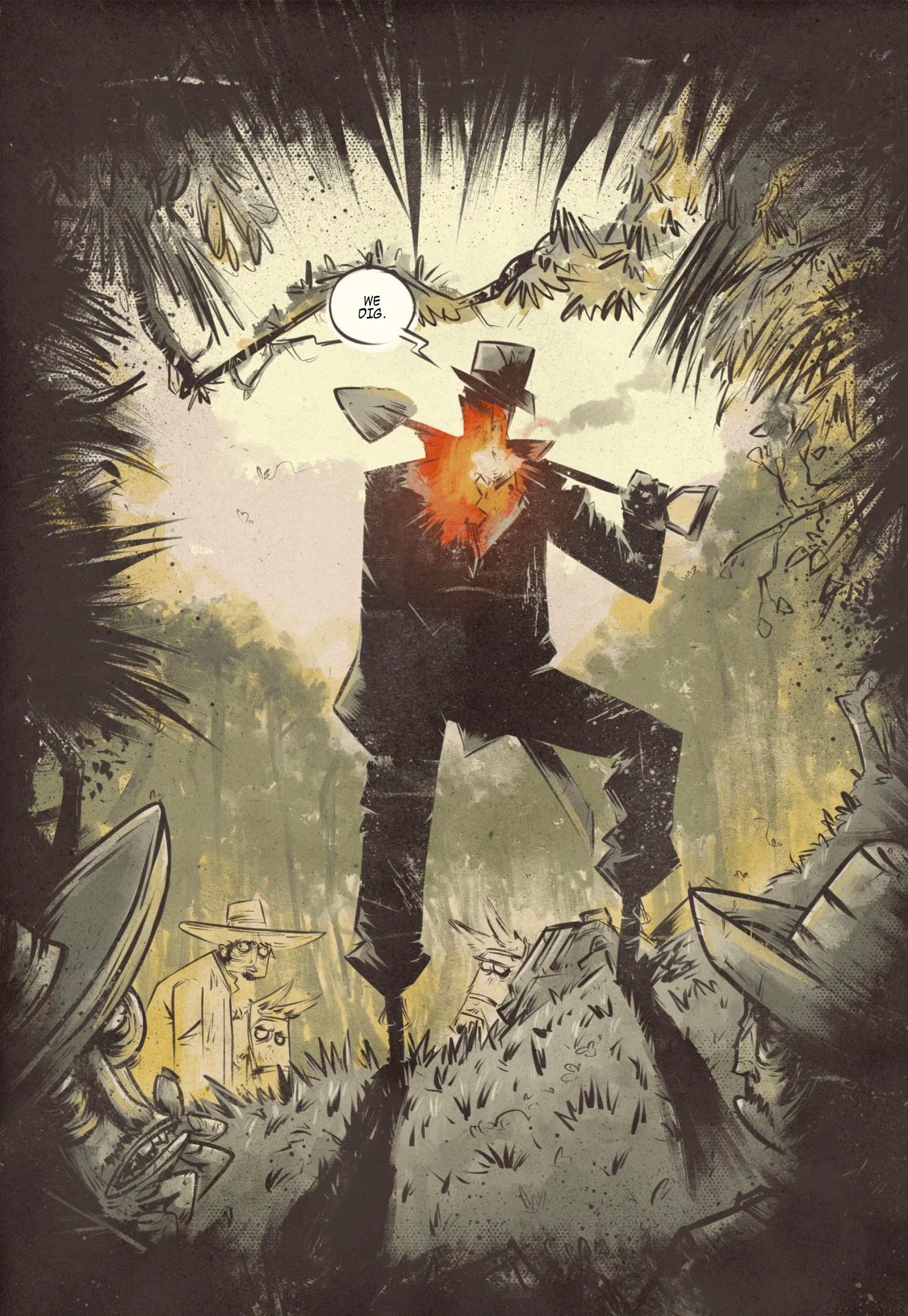
SG: I find it hard to box myself into a classic grid structure, so some elements inevitably break out of the panel borders. I also always want to make a big illustration. Usually, based on the script, I pick the most important element on the page and make it big and prominent, while the other panels add information. I borrowed that trick from Ashley Wood — that guy does incredible stuff.
I haven’t read much manga, but occasionally I come across really cool things and just borrow them. Manga does a great job with action scene dynamics and crazy panel layouts, though I’m not quite that insane, hehe.
I’m not a big fan of realism in drawing — I prefer stylized, slightly caricatured images where the artist’s style, their vision of atmosphere, perspective, and characters really shines through. That’s why I never tried to render every detail like a photograph, but rather to capture the key moments, convey the emotion, and make a cool looking image.
AAH: Did Sam’s art change the way you tackled the script?
T.S.: Oh, it for sure did. I’ve always written full-script style rather than something like Marvel style, but it’s always a dialogue between me and the artists I work with. What works best for us, for you the artist, for the book? But, what happened here was just so much trust and so much innate understanding between us. Sam, just GOT what I was going for and vice-versa. When I made references to certain types of shots or specific scenes from old movies, Sam new exactly what I was talking about and had the same instincts and built on them. So on the first issue things like a giant panel description turned into maybe a sentence and single-page splash turned into a double-page spread and so on. And once we had seen each other in action, issues 2-4 turned into a well-oiled machine. I knew exactly how to write for Sam now and he knew what to expect from me so I really let the art breath more. I knew how well Sam
could crush something as simple as a character sitting on a stump smoking and what a feast his travel scenes would turn out to be and stuff like that so I adjusted my scripts to be “wider”, more cinematic in nature. Say less, show more, let the art speak for itself because that’s really what people came to see.
AAH: Invader Comics seems very selective of the comics they put out, but everything they have put out has been fantastic. How did you get hooked up with them and what has it been like working with them?
T.S.: Invader has been awesome and the window from when I found out about them, we made The Digger, and pitched them so small it’s kind of crazy. I’m a big fan of Josh Ruben, he’s a comedian and director and he wrote this awesome, really weird and old-school style comic called Darla and it was published by Invader Comics. So, as someone trying to break into comics there’s this new publisher that’s putting out weird stuff, maybe they’re taking submissions? Right around there, Sam is finishing up the art on Issue 1 and I’m starting to get an audience on Tik Tok and they’re asking me to tell more stories on there and if I have other books I want to make. So, I started this series where I make trailers for my comic pitches and ask my audience for advice. “Where do you think I should pitch these comics, would you read it etc.” And one of my fans, now a good buddy and comics artist, Rus F., told me I should pitch it to Invader Comics. They were doing this thing called “Stitch Pitch Fridays” where you stitch their video asking for comic book pitches with your own pitch. I already had the trailer from my own series for The Digger and I was just finishing up the pitch packet to pitch to publishers so it was perfect. I sent Invader the video on social media and I sent the pitch packet proper to them with all the normal stuff: logline, summary, samples, etc. That was on a Friday. Saturday this was a comment from them on my video saying “Oh we’re aware of The Digger…” or something like that and by Monday me and Sam had a deal to publish the whole 4-issue run at Invader.
Invader Comics has been awesome throughout the process too, patient with us learning to work with a publisher, helpful when it comes to marketing, and instrumental with us getting into shops around the world. Invader was growing alongside us FAST and I think with some publishers we would’ve been left behind and instead Invader has made sure we were at the forefront next to their other awesome books. For a second near the beginning we thought we were going to lose our deal because Invader was with Diamond when they collapsed. There was no more distribution and that can really sink a small company like Invader. If you’re not selling to shops, you’re really limited in reach to the broader comics audience. I was reeling because as an indie guy, you don’t get a lot of at bats and if all these smaller publishers who would take a chance on someone small like me go under, the odds of me getting into a comic shop are slim to none and plus I LOVE indie comics so it was a big stressful mess. I remember emailing Mike Perkins, the founder and EIC at Invader Comics when I heard the news. I was like “Hey, I get it if this means the book won’t move forward or if something has to change. Will Invader be okay? Do you have a plan?” And to Mike’s credit and the rest of the amazing team over at Invader, not only did they have a plan, it was already in motion, and they never even considered dumping us lol. It was maybe a few weeks until Comics Pro and I don’t know the exact details, but Massive Indies was announced with Lunar Distribution and Invader Comics was right there in the lineup with The Digger. We couldn’t have done it without Invader Comics and their continued belief in the book is freaking everything man. I have to do a lot of grass roots marketing for myself and our book, a lot of cold calls and emails and I would say 50% of the time whoever I reach out to has already heard of the book because Invader reached out first. Not many publishers put in that kind of work on marketing especially at Invader’s level. This isn’t them with a marketing budget this is the team, the EIC, cold calling outlets asking them if they want to check out The Digger. It’s pretty rad. I love those dudes. They get it. They get comics and they love the medium and just want to put out
awesome books. Like everyone over there has made comics before so
they get it.
SG: I haven’t really had much direct contact with them — I think we only
exchanged a couple of messages on Instagram. I usually got all the info
through Luther. I didn’t notice any major issues; they were pretty
responsive to all our ideas and everything went well. I’m very grateful to
them for giving us a chance, and I hope we didn’t let them down.
AAH: This is a comic I don’t know works as well if someone else draws it. How did you two end up working together?
T.S.: So, the legend goes, I found Sam on I think…Behance, maybe Artstation? I was looking for more artists to team up with and I saw his portfolio and LOVED it. I read a foreign language comic he did called Sacrificio. His style was like this blend of Genndy Tartakovsky and Jamie Hewlett with just so much ink splatter and pulp matter around the borders. It made every inch of the page interesting to look at, but it also framed each scene like we were watching a stage play. The way he laid out panels WAS very manga like and just so kinetic. It was truly unique and I wanted to work with him so bad. So, I emailed him and asked if he had any interest in teaming up and hearing pitches. To my surprise he said yes so I wrote up some BANGERS. Some stuff I had never pitched before. Stuff I was holding close to the chest AND…he said no. LMAO he didn’t like any of the pitches. BUT instead of taking my ball and going home, he told me he liked the stuff I wrote and the style, just pitch OTHER things. So, I took a page out of Robert Kirkman’s book. I had heard him mention on Off Panel once that he doesn’t often go to an artist with a script ready. He asks them what they want to draw and he makes pitches tailored to them.
(Writers if you read this, do this shit lol.) I had heard something similar from Brian K. Vaughan working on Saga with Fiona Staples. So, Sam said he wanted to draw something Mesoamerican, he really like the architecture and the vibe, and the HISTORY of the region. He also loves old movies (like me) and was looking for something with that old-school pulp feel. I told him “No problem, I have tons of stories like that.” I did not lol. SO, I scrambled to come up with a handful of pitches that fit that description, one of the ones that Sam resonated with was “What if Indiana Jones hunted Shortround?” And that’s where we agreed to team-up, make a book, and break into American comics together.
SG: If the combination of our story and visuals really turned out well, then I definitely feel proud of the result. That’s what I always wanted to achieve. I’ve read a few reviews where people said the artist was irreplaceable for this project. That’s nice, but I’d actually love to see how someone like James Harren or Daniel Warren Johnson would draw Digger — they have such a cool, expressive style.
About how we met: I think Luther saw my work on ArtStation and wrote to me. It was a long time ago, and my pieces weren’t that great, so I’m not sure why he even noticed me, haha. We talked for a long time, and he sent me his ideas. At the time, I was really into studying ancient American civilizations. Then he sent me his concepts, and they didn’t match my interests at all, but I didn’t want to offend him. I wrote that I’d like to do something about ancient Mexico. I think he disappeared for a bit after that, and I thought he might have taken it the wrong way. But then he sent me several synopses, and I thought: “Wow, this is so cool!” I think he immediately described Digger as a dark alternative to Indiana Jones and the Temple of Doom, which completely won me over — the second Indiana Jones has always been my favorite. So that’s how we picked Digger.
P.S. I hope he’s not mad at me for rejecting his first ideas, hehe.
AAH: You made the choice to use selective color on the pages. Often when this is done one color is used like in Sin City, but you use a few. What made you want to do that?
T.S.: I have to defer to Sam on this one. At one point, early on, we talked about liking the sepia tone and the look of the old pulp adventure magazines and those pulp novels with like a poster-style cover and Sam ran with it. He brought back some concepts early-on that were that minimal color with the pops of blue and orange and I fell in love with it the same as the audience so that’s all him and I am both thankful and ENAMORED by it lol.
SG: Every project for me is an experiment, and here, making a comic inspired by old Adventure Pulp magazines with timeworn pages, I thought why not add a bit of variety with color accents. I’ve always liked street art, graffiti, poster art, and graphic design elements. In design, you highlight certain elements — I try to follow that principle in my work. So the comic has a lot of color accents, especially in issues 3 and 4. At the same time, I didn’t want to overdo it and push the story into a more mainstream palette.
We had a pretty long gap between Part 1 and Part 2. During that time, Luther was looking for a publisher for us. So in Part 2, my art style changed a bit. I hope it was for the better.
AAH: How can people follow your work?
T.S.: I’m @T.S.Luther on everything or you can check out my website
SG: I post updates on ArtStation, Behance, and Instagram.
AAH: Until next time, reporting from a corn field in Iowa, I’m crawling back into my hole. Did you know I also write comics? Or that I also do comics journalism for Comic Book Resources? If you are interested in following my work, you can find all that info here: https://linktr.ee/austinallenhamblin
Austin Allen Hamblin is a staff writer at CBR. He has written comics for Image, Source Point Press, Cosmic Lion Productions, Orange Cone Productions, and Candle Light Press.
Thanks for the interview dude!!! Great questions!